3 Takeaways from Grocery Shop on Building Content for the New Digital Shelf
From OMS Marketing Director, Molly Alderson
I just sat in on a really interesting Grocery Shop session, Essential CPG Skillsets for the “New” Digital Shelf, led by Lauren Livak Gilbert, Executive Director of the Digital Shelf Institute, and Ashley Becker, VP of Global Commerce at Kraft Heinz.
As the Marketing Director at a production company that works with CPG brands every day, a lot of the conversation felt very familiar.
Here are the three things I’m taking away from it:
1. Brands don’t just need more content. They need more useful content.
Adobe recently reported that 71% of marketers expect content demand to grow 5x or more by 2027.
That number is huge, but what stood out during this session was that filling the digital shelf isn’t simply about creating more assets.
Ashley noted that the PDP is one of the most important places a customer interacts with your brand, and every image should have a purpose.
One example shared during the session showed a Velveeta PDP/Carousel where each image communicated something different: a product benefit, use case, ingredient story, or selling point. (My photographers would kill me for sharing this low-quality iPhone photo…hopefully they don’t see this.)
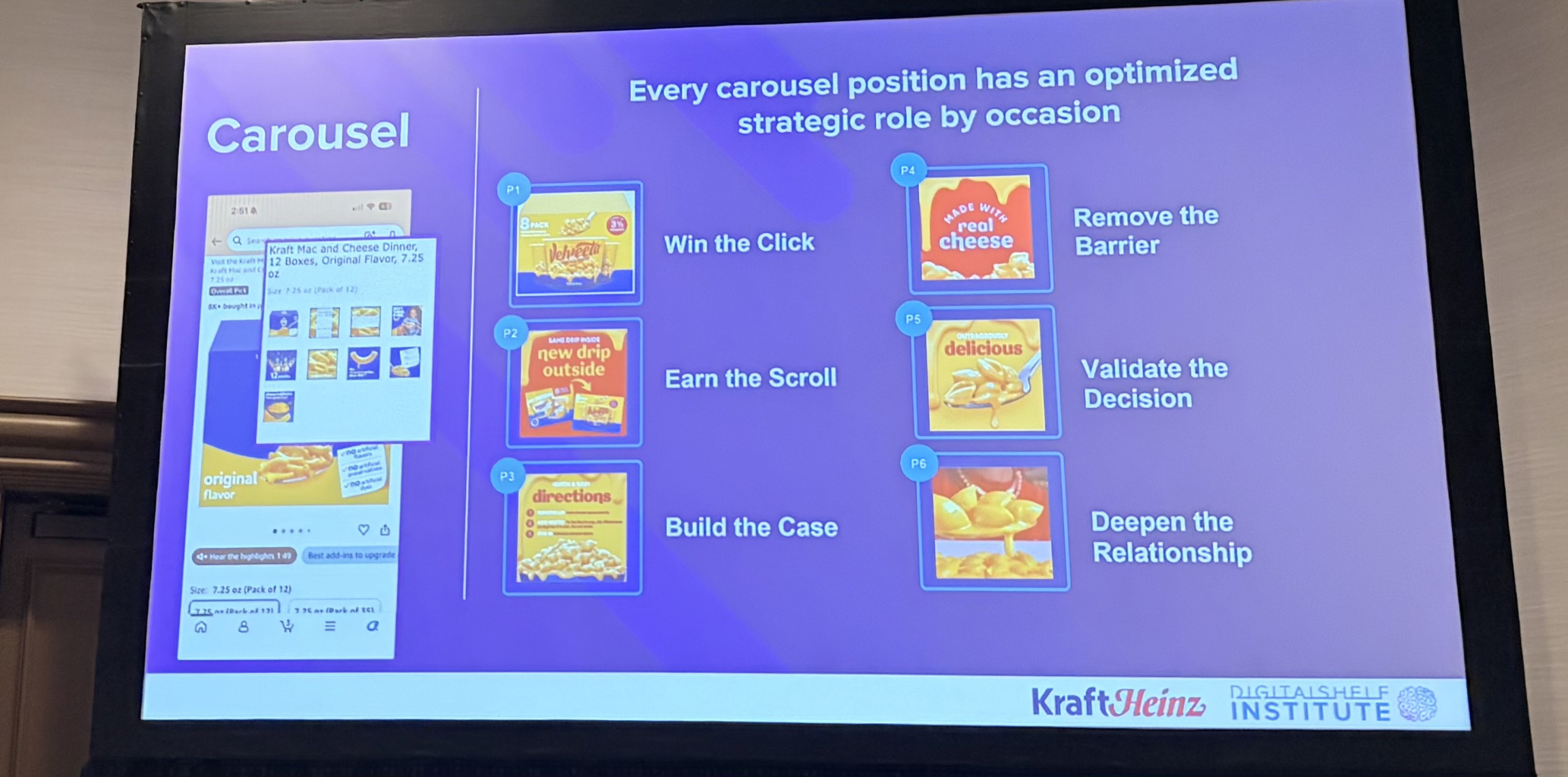
That’s a shift we’ve seen in production at OMS, too. Instead of thinking about a shoot as “we need a hero image,” we’re increasingly thinking about the entire content library a brand needs: eCommerce, lifestyle, product details, recipes, social, motion, alternate crops, multiple SKUs and everything in between.
2. The best shoots are built to create at scale.
If brands need significantly more content, producing every asset independently isn’t realistic.
That makes planning productions with scale in mind increasingly important.
Some of our favorite shoots at OMS are the ones where we can build a world around a product and then really explore it. Once the lighting, styling, props, product and creative direction are dialed in, there’s an opportunity to capture far more than one image.
Think:
- Different use cases
- Product benefits
- Details
- Ingredients
- Recipes
- Assets for different formats – like vertical or horizontal
- Social- first content
- PDP
- Maybe multiple SKUs/family shots
- Motion
- … the list goes on.
A well-planned production day can generate dozens—or even hundreds—of usable assets, depending on the objective, without requiring completely separate productions for every need.
And creatively, those are often some of our favorite shoots. Once the must-haves are covered, there’s room for the photographer, stylist, agency and brand team to experiment, explore different ideas and make the most of everything already happening on set.
3. “Always-on” really does mean always on.
An audience question toward the end of the session asked about seasonal content and how important it is to continually refresh what consumers are seeing.
The answer was essentially: it’s difficult to manage and scale, but it matters.
Between seasonal moments, new products, retailer requirements, new platforms and changing specifications, brands can’t build one content library and expect it to last forever.
This might actually be the takeaway that resonated most with me.
We have brands that come back to OMS throughout the year because we’re not starting from scratch every time. We already know their team, products, visual language and brand guidelines. Our photographers and stylists understand how the product should look on set, and our retouching team knows the specs, color standards and finishing details expected in the final assets.
We also know what worked last time…and what didn’t.
That familiarity makes it much easier to respond when a brand suddenly needs content for a seasonal push, new SKU, retailer request or platform update. Instead of rebuilding the process with every project, we can pick up where we left off and keep creating content that feels consistent with the brand.
Overall Takeaway
The digital shelf conversation is obviously much bigger than photography and video. But from where I sit, production is becoming a pretty important piece of the puzzle.
The challenge isn’t just figuring out how to make more content. It’s figuring out how to build a production system that can keep creating the right content at scale, across channels, without starting from scratch every time.
For us, that’s one of the most interesting production challenges facing CPG brands right now and one we’re thinking about a lot at OMS.